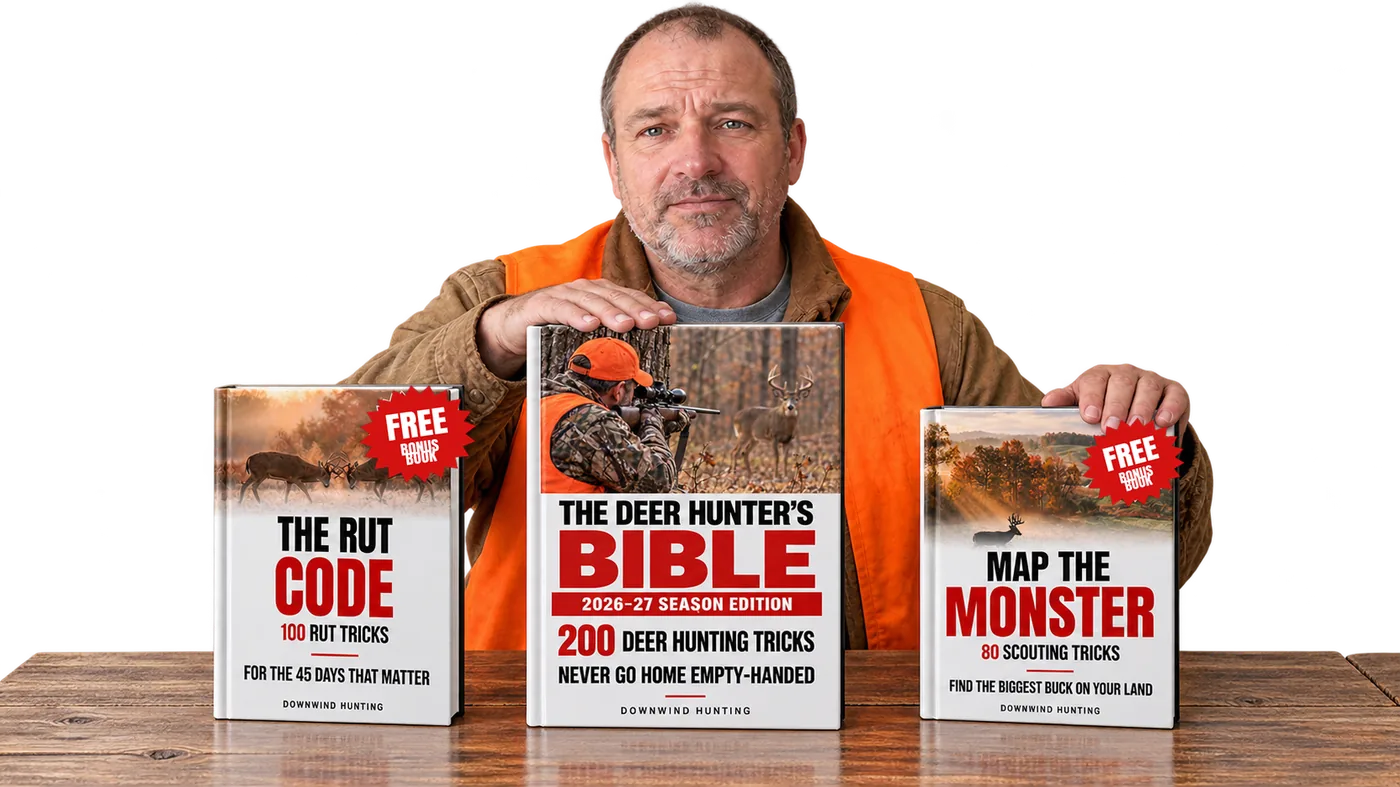
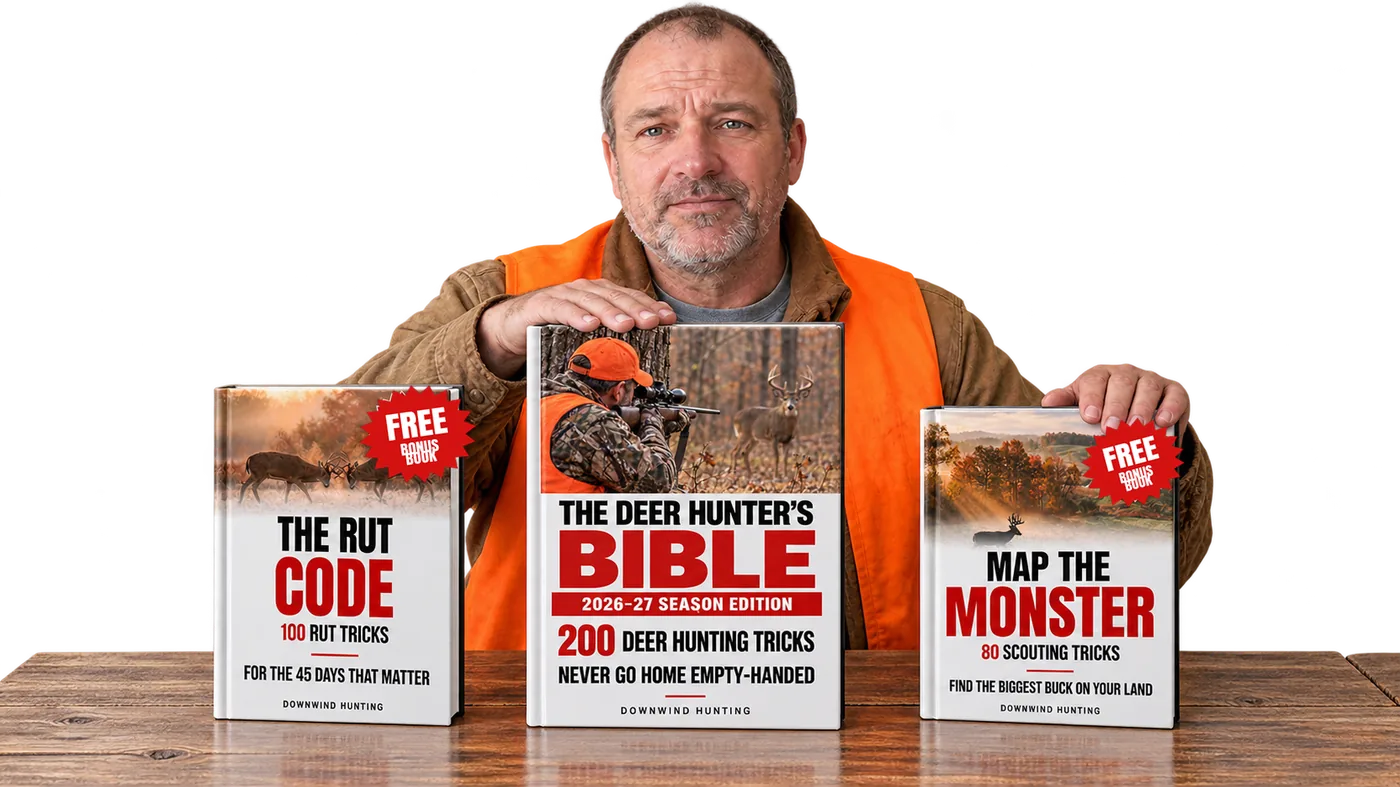
Newly expanded to 101 field-tested tricks. 336 pages of dense, real-world tactics — no 40-page intro, no padded chapters. Every page is a trick you can use this season.
The Buck Hunter's Bible ($49) + 30-Day Opening Day Roadmap ($25 FREE) — bundled together.
Get Instant Access — $17.99You washed your clothes. You played the wind. You hung a stand in a textbook funnel. You set a camera. You sat. And the buck never showed — or showed at 2:14 a.m., three weeks in a row. That's not a basics problem. That's the next problem. And it has its own answers.
You've got a mature buck on camera every three days. Every single photo is between 1:30 and 4 a.m. He's real. He's on your property. And he's never been on his feet in legal light.
The spot that killed for three seasons went cold last year. You're still sitting it out of habit. The deer moved 80 yards and you never adjusted.
Fresh rubs. Beat-down trails. Scrapes opened back up. Everything looks textbook — and you sit it and see nothing. Sign that looks good in the morning is empty by dark.
It's opening week on public land and the parking lot is full at 4 a.m. The deer are still there — you're just hunting where every other hunter is, on the same wind.
November came. You took the week off. You saw four does and a spike. The rut wasn't dead — you were hunting it like it was one event instead of three distinct phases.
The best front of the month landed on a Tuesday when you were at work. You sat the weekend in 60° weather and saw nothing. There's a fix — and it doesn't require quitting your job.
"The first rule is learning the basics. The second is knowing what to do when the basics are not enough. This book is the second rule."— The Buck Hunter's Bible
The most complete edition we've ever released. Every trick follows the same seven-part structure: the problem, why it costs you deer, the better move, when to use it, when to avoid it, a cheap field version, and a one-sentence rule for when you're cold and tired in the stand at 4 a.m.
Bucks that live on your camera but never in legal light. How to read the nocturnal photo, find the daylight section of his route, and put a stand where he's actually killable.
Where most hunts are lost — not in the stand, but on the walk in. Access routes, sound discipline, scent management on approach, and how to enter a spot without burning it.
Stands that produced for years and stopped. How to diagnose what changed, when to move 40 yards versus when to retire the spot entirely, and how to recover a burned area.
Fresh rubs, hot scrapes, and beat-down trails that mean nothing. How to tell sign that's actually predictive from sign that's two weeks behind the buck.
Other hunters are half of your reality. Reading neighbor pressure, public-land access patterns, and using the human map to find the spots everyone else just walked past.
Three phases, not one event. Why the tactics that kill on November 5 are dead wrong on November 12, and which two days of the rut produce more mature bucks than the rest combined.
Stillness, patience, and the small disciplines that separate hunters who kill mature deer from those who keep almost killing them. The things nobody films on YouTube.
Field substitutions for $400 gadgets. A $4 grocery item that outperforms most $22 attractants. The setups that work just as well without the budget.
For hunters with jobs. The narrow windows when mature bucks move predictably, and how to plan a short sit that beats a four-hour sit on the wrong day.
The shot, the wait, the recovery. The mistakes that lose deer between the shot and the tag — and the small disciplines that recover the marginal hits other hunters give up on.
The 30 days before opening morning are when the season is actually won or lost. Most hunters spend them doing nothing — or doing the wrong things in the wrong order. This roadmap fixes that. One focused action per day. Seven stages. By Day 30, you walk into opening morning more prepared than any hunter you'll share the woods with.
The complete field manual for in-season decisions, plus the day-by-day plan to walk into opening morning ready. No gear ads. No $400 gadgets. Just the moves that work.
Veterans with 20+ seasons and guys on their fourth year. Different experience levels. Same result.
"Had a buck on camera every three days for a month. All between 2 and 4 a.m. Read Chapter 1, mapped his probable bed upwind, hung a second camera between the bed and the food. First daylight photo in two weeks. Killed him eight days later. I'd been sitting the wrong end of his route for a year."
"Used the 30-day roadmap for the first time this year. Day 6, the border walk — found a new neighbor stand 80 yards off my west line I hadn't noticed. Shifted my whole stand strategy east and tagged out opening week. Without that book I'd have been sitting the wrong side of the property all season."
"Only my fourth season. I was about to quit. Chapter 6 on the rut phases changed everything — I had no idea peak-rut tactics were wrong during the seeking phase. Switched my whole November strategy and tagged my first buck with a bow. Nobody had ever explained the three phases like that."
"The chapter on dead stands — that hit hard. I had a spot that killed three years in a row and went cold. I kept sitting it. Turns out a logging operation cleared the bedding 200 yards south and the deer relocated. Moved my stand 90 yards north. Killed a 9-point on the third sit."
"Chapter 9 on ninety-minute windows is what made this worth the price. I work full time and can't take weeks off. Started hunting only the two windows the book identifies. Saw more mature deer in three short sits than the prior season in fifteen. Quality of time, not quantity."
"Hunt public land. The Human Map chapter is worth the whole book. Found a 40-acre pocket within a mile of the parking lot that nobody hunts because the access route looks bad on a map. Tagged two bucks there this season. Same ground 200 hunters drive past every weekend."
Digital only — a single PDF (336 pages, including the 60-page bonus roadmap) delivered instantly to your email after purchase. No shipping, no waiting. Read it on your phone, tablet, or computer, and print any chapter you want to take to the field.
This book is written for hunters who already do the fundamentals right and still aren't killing the deer they should be killing. Every chapter starts with a problem most experienced hunters have run into, and walks through the fix. If you're a beginner, start with the basics first. If you've got years in the woods and something isn't clicking — this is for you.
A day-by-day plan for the 30 days before opening morning. Seven stages: scouting, camera deployment, reading the data, stand decisions, physical prep, weather watching, and the opening day protocol. One focused action per day. Some days take an hour, some take three. Sells for $25 on its own — yours free with the bundle.
Yes. Stand placement, sign reading, rut phases, scent and wind discipline, dead-stand diagnosis — all apply regardless of weapon. Specific weapon-related notes are called out where they matter (Chapter 10 on shot placement and recovery applies differently for archery and rifle).
Yes — Chapter 5 (The Human Map) is built specifically around reading other hunters and finding the spots they walk past. The 30-Day Roadmap also has public-land adaptations called out throughout. Public-land hunters often get more out of this book than private-land hunters, because the gap between average and intelligent is bigger.
Whitetail behavior across the entire eastern U.S., Midwest, and South. Regional notes throughout for northern vs. southern deer, terrain differences, and where pressure patterns change by geography.
YouTube has a financial incentive to keep you watching and buying gear. This book has one incentive: helping you kill more deer. The advice here directly contradicts a lot of sponsored content — because it doesn't sell anything except the book.
Email us within 30 days at the address in your receipt and we'll refund you in full. No questions, no friction. We're confident enough in the book that we make this easy.
You've got the land. You've got the gear. You've put in the years. The only thing standing between you and a filled tag is what's in this book.